What is the Change?
- Changes specifically requested by the Employer (According to Standard document for Building & Civil Engineering works-3rd edition-generally known as Oman Conditions of Contract 3rd edition & FIDIC 4th edition 1987 version)
- Change proposals or notices from the Contractor (As per New Oman Conditions -2019 Rev.01 and FIDIC 1999 & 2017)
| Change Type | Description |
|---|---|
| Design Changes | Modification or revisions to the design & specifications |
| Scope Changes | Modification or revisions to the Scope of work |
| Programme Changes | Result of the above design or scope changes can be impact to the programme, which affect the duration, sequence, or milestones of the project |
| Cost Changes | Result of the above design or scope or programme changes can be effect to the cost |
Reasons for the Changes?
| Reason for Change | Typical Trigger |
|---|---|
| Employer Change | The Employer alters a requirement, preference or priority after award |
| Operator Change | The end operator/occupier requests an amendment, often post-handover or during fit-out coordination |
| Value Engineering Proposal | The Contractor proposes an alternative that reduces cost or time while maintaining performance |
| Design Change | The design consultant revises drawings or specifications during development |
| Site Change | Actual site or ground conditions differ from what was assumed at tender |
| Contractor’s Proposal | The Contractor identifies a buildability or programme improvement |
| Statutory Authority Requirement | A regulator, municipality or utility authority imposes a new legislation |
| Project Representative’s Recommendation | The Employer’s representative or project manager recommends an amendment based on site observation |
Why Change Management Matters to the Quantity Surveyor?
What are the tools and methods available for change management?
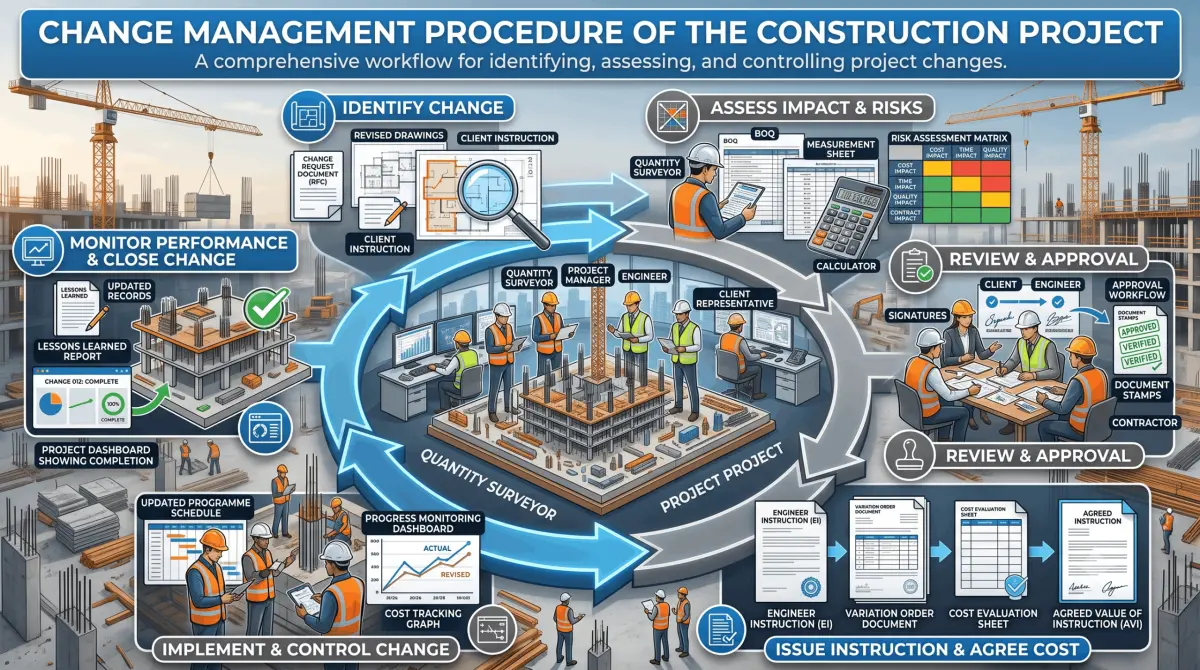
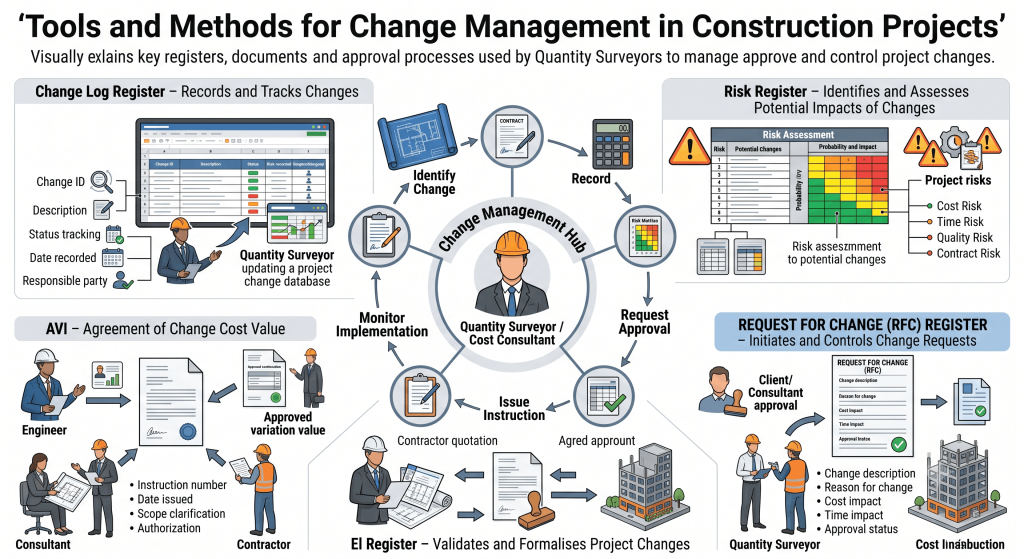
Change management involves identifying, assessing, and managing changes. Quantity Surveyors can use various tools and methods to facilitate and enhance their change management process.
- Change log register – to register, records and track the changes.
- Risk register – to understand the potential changes
- Request for Change (RFC) register – to initiate the changes
- Engineer Instruction (EI) register – to validate & formalise the changes
- Agreed value of Engineer’s Instruction (AVEI) – to agree on the actual cost of the change
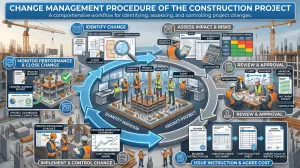
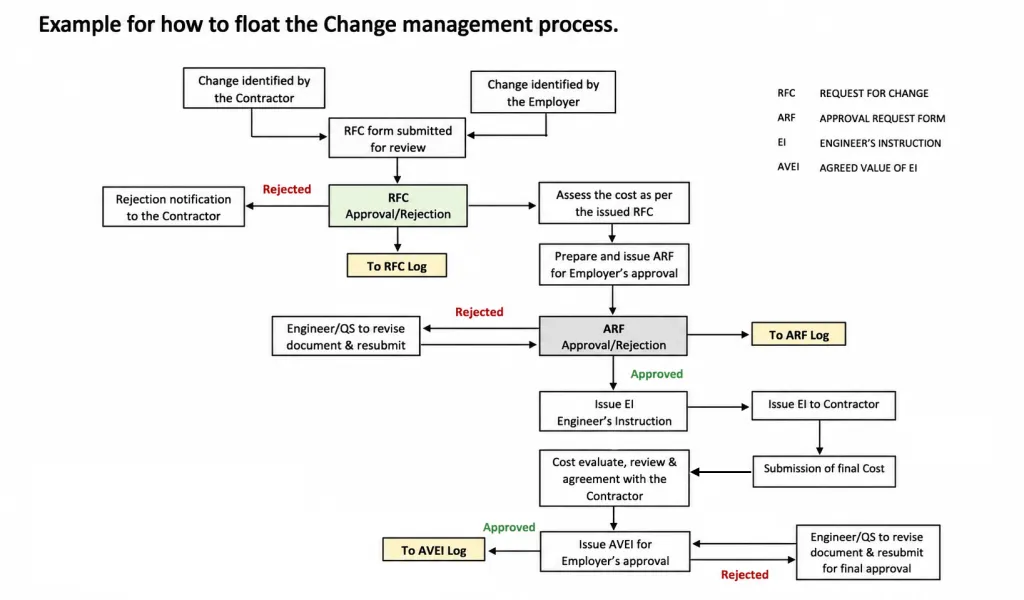
Example for how to float the Change Management Process
Legend: RFC — Request for Change · ARF — Approval Request Form · EI — Engineer’s Instruction · AVEI — Agreed Value of EI
Change Management Risk Assessment
Improve Your Change Management Skills as a Quantity Surveyor
Frequently Asked Questions
What is change management in a construction project?
It’s the structured process of identifying, assessing, approving and recording any amendment to the originally intended scope of works. It acts as a cost and time control mechanism, giving the Employer the opportunity to accept or reject a proposed change before it’s implemented.
What’s the difference between a “change” and a “variation”?
A change is any amendment to the intended scope of works. It only becomes a formal “variation” once it’s captured through an Engineer’s Instruction (EI) issued under the relevant clause of the Conditions of Contract — not every proposed change ends up being instructed.
What are the two main sources of a change?
Changes are either specifically requested by the Employer, or raised as a proposal or notice from the Contractor. From there they’re typically categorised further as design, scope, programme, or cost changes.
What triggers a change on most projects?
Common triggers include employer or design changes, site conditions differing from what was assumed at tender, value engineering proposals, statutory authority requirements, or a recommendation from the project representative — this is usually captured on the RFC form itself via a standard checklist.
What is an RFC (Request for Change)?
The document that formally raises a proposed change. It records the originator, the reason for change, a description of the proposed scope, and a preliminary cost/time estimate, before being reviewed by the Engineer or QS.
What is an ARF (Approval Request Form)?
The next stage after an RFC is accepted for assessment. It carries the detailed cost breakdown (labour, materials, plant, overheads and profit) and time impact, and ends with the Employer’s decision to approve, reject, or send it back for revision.
What is an EI (Engineer’s Instruction)?
The formal instruction to the Contractor to proceed with the change, issued once the ARF is approved. It references the contract clause relied on and states the provisional value and any time impact, and isn’t valid until signed by both the Engineer’s and Employer’s authorised representatives.
What is an AVEI (Agreed Value of Engineer’s Instruction)?
The final stage, where the actual cost of the instructed work is agreed and formally settled between Contractor, Engineer and Employer — typically including a statement that the amount represents full and final settlement, with no further claim to follow.
Why does change management matter to a Quantity Surveyor?
Poorly managed changes cause cost overruns, delays and disputes. The QS is responsible for keeping the project within its approved budget while ensuring the Employer gets value for money — which requires tracking every change from RFC through to AVEI.
What tools are used to manage change on a project?
A change log register, a risk register, and dedicated RFC, EI and AVEI registers are the core tools — they let the change history be tracked, reported by cause, and reconciled into the final account.