


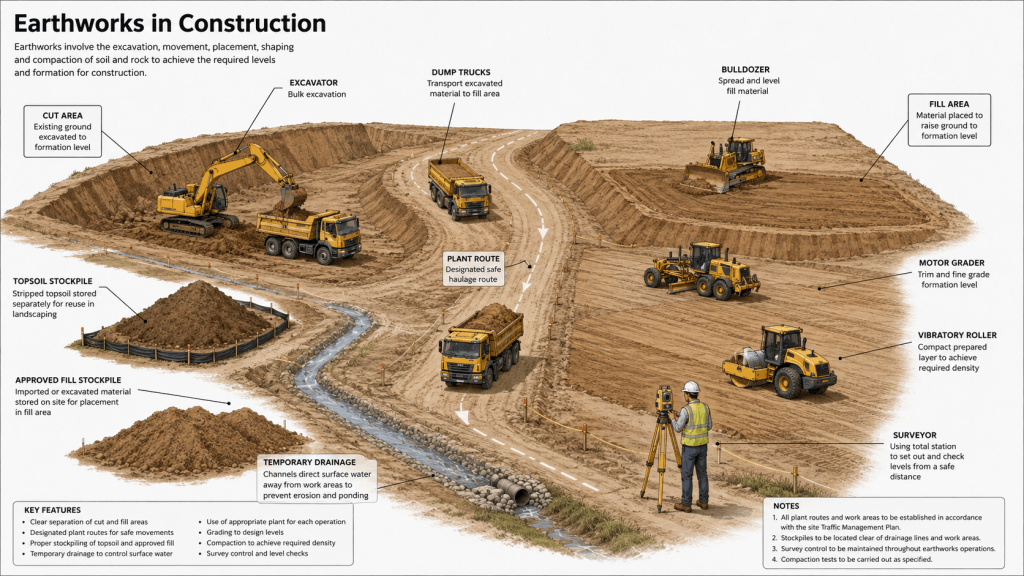
Earthworks in Construction
Earthworks in construction include the excavation, movement, placement and compaction of soil or rock to achieve the required ground levels for a project. These activities are normally carried out during the early stages of buildings, roads, bridges, utilities and infrastructure works.
The quality of earthworks directly affects foundation stability, pavement performance, drainage and the long-term settlement of the completed structure. Poor excavation control, unsuitable fill material or inadequate compaction can lead to differential settlement, cracked floors, damaged services and failed external works.
This article explains the main types of earthworks, construction methods, equipment, quality inspections, testing requirements, safety controls, measurement rules and cost factors. It also includes a practical work sequence, earthwork volume calculation and site inspection checklist.
What Are Earthworks in Construction?
Earthworks are construction activities that change the existing ground profile to match the levels and shapes shown on the approved drawings.
The work may involve:
- Clearing the site.
- Removing topsoil.
- Excavating soil or rock.
- Loading and transporting excavated material.
- Stockpiling reusable soil.
- Disposing of unsuitable material.
- Filling low areas.
- Compacting fill in layers.
- Trimming formation levels.
- Preparing ground for foundations, roads or landscaping.
Earthworks are not limited to excavation. Excavation removes material from the ground, while earthworks cover the complete process of cutting, moving, filling, grading and compacting.
Cut and Fill

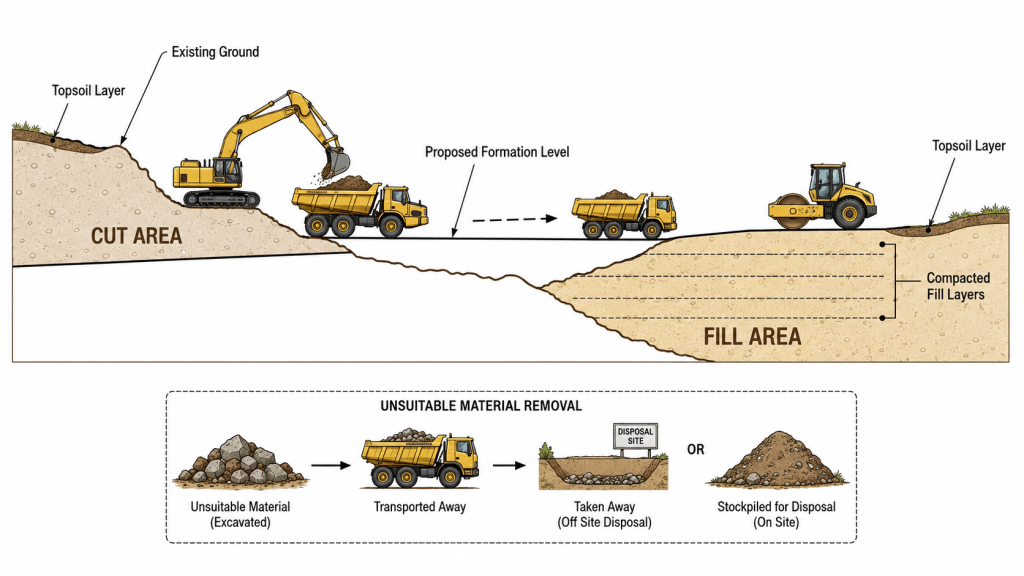
Cut and fill is one of the main principles of earthwork planning.
- Cut means removing material from areas above the required formation level.
- Fill means placing approved material in areas below the required formation level.
An efficient earthwork plan attempts to reuse suitable excavated material within the project. This can reduce imported fill, disposal quantities, transport movements and environmental impact.
However, excavated soil should only be reused when it satisfies the project specification. Material containing organic matter, waste, excessive moisture, soft clay or oversized particles may be unsuitable for structural filling.
Applications of Earthworks in Construction
Earthworks are required in most construction projects.
Building Projects
Earthworks for buildings may include:
- Excavation for foundations and pile caps.
- Excavation for basements.
- Filling below ground-floor slabs.
- Formation of access roads and parking areas.
- Grading around completed buildings.
- Excavation for underground water tanks and service rooms.
Road and Highway Projects
Road earthworks commonly include:
- Cutting through high ground.
- Constructing embankments.
- Preparing road formation.
- Removing unsuitable subgrade.
- Installing selected fill.
- Shaping side slopes.
- Forming drainage channels.
Bridges and Infrastructure
Earthworks may be required for:
- Bridge abutments.
- Approach embankments.
- Retaining structures.
- Culverts.
- Utility corridors.
- Railway formations.
- Flood protection embankments.
Underground Services
Excavation and backfilling are carried out for:
- Drainage pipes.
- Water supply lines.
- Electrical cables.
- Telecom ducts.
- Fire mains.
- Irrigation systems.
- District cooling services.
Industrial Projects
Industrial earthworks may include large-scale grading, equipment foundations, tank farms, pipe corridors, heavy-duty yards and temporary construction platforms.
Main Types of Earthworks
Earthworks can be classified according to the nature and purpose of the activity.
| Earthwork Type | Description | Typical Application | Main Limitation |
|---|---|---|---|
| Site clearance | Removal of vegetation, debris and surface obstructions | Initial site preparation | Does not normally include major excavation |
| Topsoil stripping | Removal of organic surface soil | Building platforms, roads and landscaping | Topsoil is generally unsuitable below structural works |
| Bulk excavation | Large-volume removal of soil | Basements, roads and major level reduction | Requires access for heavy equipment and haulage |
| Reduced-level excavation | Excavation to a specified platform or formation level | Buildings and external works | Accurate survey control is required |
| Trench excavation | Narrow excavation for services or foundations | Pipes, cables and strip footings | Collapse and access risks increase with depth |
| Rock excavation | Removal of hard rock using breakers, ripping or controlled blasting | Foundations, roads and underground works | Higher cost, noise and vibration |
| Filling and embankment | Placement of approved soil or granular material | Roads, platforms and landscape areas | Must be compacted in controlled layers |
| Grading | Shaping the ground to the required slope and level | Roads, drainage and landscaping | Final tolerances depend on the following construction layer |
| Dredging | Removal of underwater soil or sediment | Marine works, ports and channels | Requires specialist equipment and environmental controls |
Earthwork Materials
The suitability of earthwork material depends on its grading, strength, plasticity, moisture condition and intended use.
Natural Excavated Soil
Excavated soil may be reused when testing confirms that it is suitable for the proposed location.
Suitable material should generally be:
- Free from rubbish and organic matter.
- Free from roots and vegetation.
- Capable of being compacted.
- Within the specified particle-size range.
- At a suitable moisture condition.
- Accepted by the Engineer or consultant.
Selected Fill
Selected fill is material chosen to meet specified engineering properties. It may be obtained from approved excavated material, borrow pits or commercial suppliers.
It is commonly used below:
- Foundations.
- Ground-bearing slabs.
- Roads.
- Parking areas.
- Hard landscaping.
- Service trenches.
Granular Fill
Granular fill generally contains sand, gravel or crushed aggregate. It normally drains better and is easier to compact than highly plastic clay.
The exact grading and material requirements should follow the approved project specification.
General Fill
General fill may be used in non-critical areas where high structural performance is not required. It should still be free from harmful material and placed in controlled layers.
Topsoil
Topsoil contains organic matter and supports plant growth. It is normally stripped from structural areas and stockpiled for reuse in landscaping.
Topsoil should not be placed below foundations, road pavements or structural slabs unless specifically approved.
Unsuitable Material
Unsuitable material may include:
- Organic soil.
- Peat.
- Waste or contaminated soil.
- Very soft clay.
- Highly expansive soil.
- Material containing excessive debris.
- Material that cannot be compacted.
- Material with excessive moisture.
- Excavated soil rejected by testing or inspection.
Unsuitable material should be removed to an approved disposal location or treated using an approved ground-improvement method.
Plant and Equipment Used for Earthworks
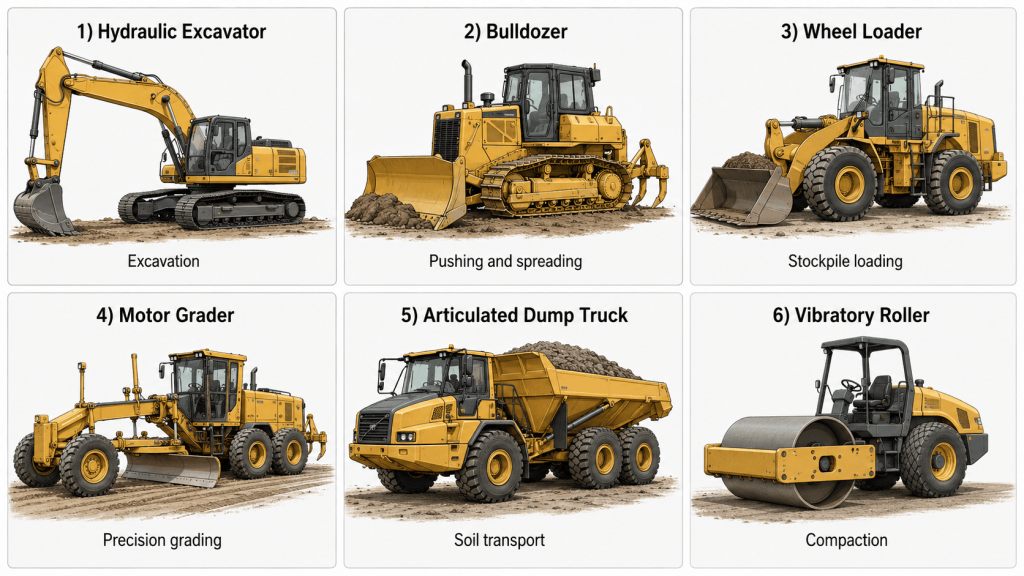
The selected plant depends on the soil type, excavation depth, quantity, access and haul distance.
Excavators
Hydraulic excavators are used for bulk excavation, foundation excavation, trenching, rock breaking and loading trucks.
Common attachments include:
- General-purpose buckets.
- Trenching buckets.
- Rock buckets.
- Hydraulic breakers.
- Rippers.
- Compaction plates.
Bulldozers
Bulldozers push and spread soil over short distances. They are useful for site stripping, rough grading, embankment filling and maintaining haul roads.
Loaders
Wheel loaders load loose material into trucks, move stockpiles and handle imported fill.
Motor Graders
Motor graders provide accurate trimming and levelling. They are commonly used for road formation, platforms, haul roads and final grading.
Dump Trucks
Dump trucks transport excavated soil, rock and imported fill. The truck type and capacity should suit site access, road conditions and loading equipment.
Compaction Equipment
Compaction plant may include:
- Smooth-drum rollers.
- Padfoot rollers.
- Pneumatic-tyred rollers.
- Vibratory rollers.
- Plate compactors.
- Trench rollers.
- Tamping rammers.
Heavy rollers are suitable for open areas. Plate compactors and rammers are normally required near structures, inside trenches and around services.
Water Tankers
Water tankers control moisture content and dust. Water should be applied evenly and should not cause ponding or soil softening.
Survey Equipment
Surveyors may use:
- Total stations.
- Automatic levels.
- GPS surveying equipment.
- Laser levels.
- Levelling staffs.
- Survey markers and reference pegs.
Survey control is required throughout excavation, filling and final formation preparation.
Earthworks Construction Sequence

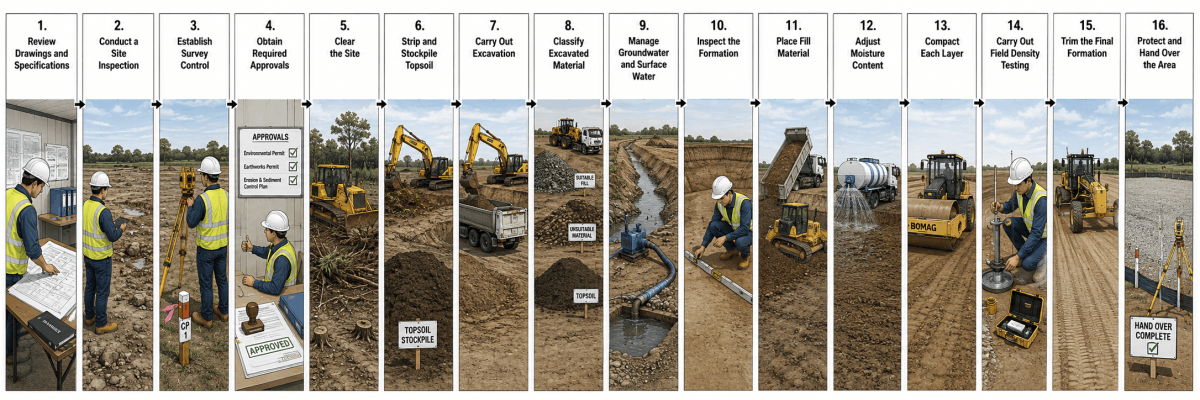
1. Review Drawings and Specifications
The construction team should review:
- Existing and proposed levels.
- Site grading drawings.
- Foundation drawings.
- Utility drawings.
- Geotechnical information.
- Earthwork specifications.
- Temporary works requirements.
- Disposal and stockpile areas.
This review helps identify excavation depths, fill zones, groundwater risks, existing services and restricted working areas.
The site engineer, surveyor, QA/QC engineer and construction manager normally coordinate this stage.
A common mistake is starting excavation using architectural levels without confirming structural formation levels and foundation details.
2. Conduct a Site Inspection
The work area should be inspected before equipment enters the site.
The inspection should identify:
- Existing buildings and structures.
- Overhead cables.
- Underground utilities.
- Access restrictions.
- Soft ground.
- Standing water.
- Trees and vegetation.
- Adjacent roads and properties.
- Environmental restrictions.
Existing services should be confirmed through available drawings, utility records, detection equipment and trial pits where required.
3. Establish Survey Control
The surveyor establishes permanent or temporary benchmarks outside the active work area.
The survey team should mark:
- Site boundaries.
- Excavation limits.
- Cut and fill areas.
- Formation levels.
- Batter lines.
- Foundation positions.
- Service routes.
- Safe offsets.
Survey points should be protected from construction traffic and regularly checked.
4. Obtain Required Approvals
Before starting earthworks, the contractor should have the required approved documents, which may include:
- Method statement.
- Risk assessment.
- Inspection and test plan.
- Earthwork drawings.
- Temporary excavation design.
- Material submittals.
- Disposal permits.
- Traffic management plan.
- Dewatering proposal.
- Environmental control plan.
The exact approvals depend on the project and local authority requirements.
5. Clear the Site
Vegetation, waste, abandoned foundations and surface obstructions are removed from the working area.
Reusable material and waste should be separated. Disposal should be carried out only at approved locations.
Site clearing should not damage survey benchmarks, protected trees, retained structures or known services.
6. Strip and Stockpile Topsoil
Topsoil is stripped to the depth identified in the specification or site investigation.
It should be stockpiled separately from structural fill. Stockpiles should be located away from drainage channels and active construction routes.
Mixing topsoil with suitable excavated soil can make otherwise reusable material unsuitable for filling.
7. Carry Out Excavation
Excavation normally proceeds in stages to maintain access and stability.
The operator excavates close to the required level. Final trimming may be completed using smaller equipment or manual methods.
Excavation should be continuously checked for:
- Correct depth.
- Correct dimensions.
- Stable side slopes.
- Groundwater.
- Unexpected utilities.
- Soft spots.
- Changes in soil condition.
- Over-excavation.
The excavation should not remain open longer than necessary, especially in weak soil or during wet weather.
8. Classify Excavated Material
Excavated material should be separated into:
- Suitable material for reuse.
- Topsoil.
- Rock.
- Unsuitable material.
- Contaminated material, where applicable.
Suitable material may be stockpiled for filling. Stockpiles should be managed to avoid contamination, erosion and excessive moisture.
The final decision on reuse should follow testing and consultant approval.
9. Manage Groundwater and Surface Water
Water should not be allowed to collect in excavations or on prepared formation.
Control measures may include:
- Diversion drains.
- Sumps and pumps.
- Wellpoint systems.
- Drainage channels.
- Temporary berms.
- Waterproof covers.
- Staged excavation.
Uncontrolled pumping can remove fine soil particles or affect nearby foundations. Dewatering should follow an approved method where groundwater is significant.
10. Inspect the Formation
After excavation reaches the required level, the formation is cleaned and inspected.
The inspection normally checks:
- Level and dimensions.
- Soil condition.
- Presence of loose material.
- Soft or disturbed areas.
- Water accumulation.
- Agreement with geotechnical information.
- Suitability for the next construction activity.
Soft spots should be removed and replaced with approved material or treated as directed.
Concrete blinding, foundations or pavement layers should not be placed until the formation is accepted.
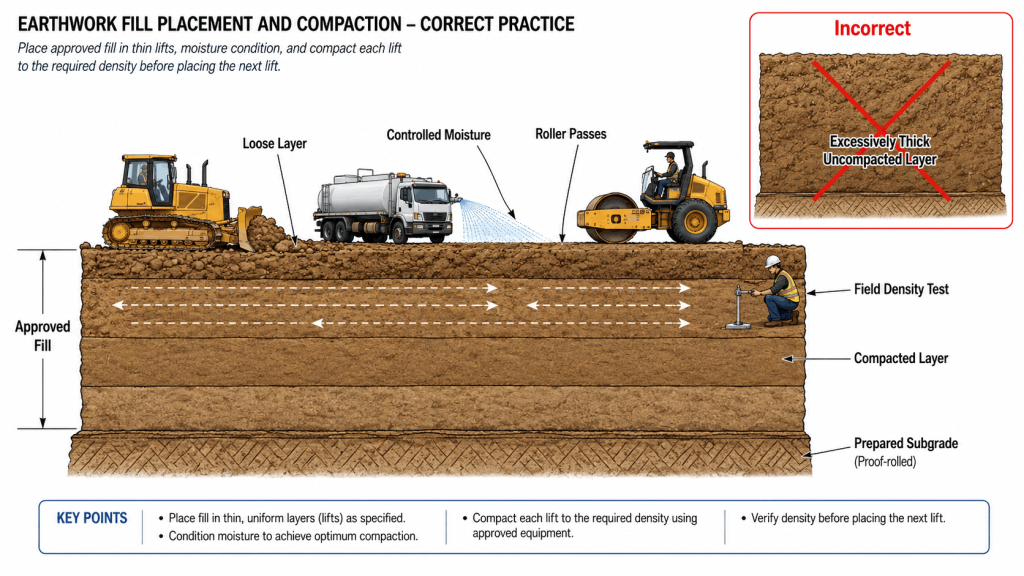
11. Place Fill Material
Approved fill is spread in controlled horizontal layers.
The loose layer thickness depends on:
- Material type.
- Compaction equipment.
- Required density.
- Test results.
- Approved method statement.
Thick layers may compact near the surface but remain loose at the bottom. This can cause settlement after construction.
Large stones, waste and unsuitable material should not be hidden within the fill.
12. Adjust Moisture Content
Fill material should be close to the moisture condition required for effective compaction.
When the soil is too dry, water may be added and mixed evenly. When it is too wet, it may require aeration, turning, blending or replacement.
Adding water only to the surface without proper mixing can produce inconsistent compaction.
13. Compact Each Layer
Each layer is compacted using approved equipment and a controlled number of passes established through the method statement or trial area.
Compaction should cover the complete area, including:
- Edges.
- Corners.
- Areas around foundations.
- Locations near retaining walls.
- Service crossings.
- Confined spaces.
Smaller compaction equipment is normally required where heavy rollers cannot safely operate.
14. Carry Out Field Density Testing
Field density tests are performed at the required frequency.
Failed areas should be:
- Identified and marked.
- Investigated.
- Moisture-adjusted or reworked.
- Recompacted.
- Retested.
The next layer should not cover a failed area unless an approved corrective action has been completed.
15. Trim the Final Formation
After completing the filling or excavation, the final surface is graded to the required levels and slopes.
The surveyor checks:
- Formation level.
- Crossfall.
- Longitudinal slope.
- Platform dimensions.
- Drainage direction.
- Tie-in with adjacent areas.
Loose, disturbed or muddy surfaces should be corrected before the next layer is placed.
16. Protect and Hand Over the Area
Accepted formation should be protected from:
- Construction traffic.
- Rainwater.
- Contamination.
- Uncontrolled excavation.
- Storage of heavy materials.
- Damage by other trades.
The handover may include survey records, inspection approvals, density-test reports, material approvals and as-built levels.
Earthworks Quality Control and Inspection
Quality control should begin before excavation and continue until the completed formation is handed over.
Main Quality Documents
Typical documents include:
- Approved drawings.
- Approved method statement.
- Inspection and test plan.
- Material approval.
- Geotechnical report.
- Survey reports.
- Field density test reports.
- Laboratory test reports.
- Inspection requests.
- Disposal records.
- As-built survey.
- Non-conformance and corrective-action records.
Material Inspection
Imported fill should be checked against the approved source and material submittal.
The inspection may include:
- Supplier details.
- Delivery tickets.
- Visual condition.
- Particle size.
- Moisture condition.
- Contamination.
- Laboratory test certificates.
Material from an unapproved source should not be incorporated into the permanent works.
Work Inspection
A work inspection request may be required for:
- Excavation limits.
- Foundation formation.
- Removal of unsuitable material.
- Each compacted layer or defined area.
- Final formation.
- As-built levels.
The inspection sequence should follow the approved inspection and test plan.
Practical Acceptance Points
The site engineer and QA/QC inspector should verify that:
- Excavation dimensions match the drawings.
- Formation levels are correct.
- Loose soil has been removed.
- Soft areas have been treated.
- Fill material is approved.
- Fill has been placed in controlled layers.
- Moisture has been properly distributed.
- Compaction covers edges and confined areas.
- Test locations represent the completed work.
- Failed test areas have been corrected.
- Final drainage falls are correct.
- Records are complete and traceable.
Earthwork Testing Requirements
Testing requirements depend on the material, proposed use and project specification.
Soil Classification Tests
Soil classification helps determine whether the material is suitable for earthworks.
Tests may include:
- Particle-size distribution.
- Sieve analysis.
- Hydrometer analysis for fine material.
- Liquid limit.
- Plastic limit.
- Plasticity index.
- Natural moisture content.
- Organic content where relevant.
Moisture-Density Relationship
A laboratory compaction test establishes the relationship between soil moisture and dry density.
The results normally provide:
- Maximum dry density.
- Optimum moisture content.
These values are used as a reference for field compaction control.
The applicable laboratory method should be stated in the project specification.
Field Density Test
A field density test checks the achieved dry density of the compacted layer.
Common methods include:
- Sand replacement.
- Core cutter, where suitable.
- Nuclear density gauge.
- Other approved in-situ density methods.
The field result is compared with the laboratory reference density and the specified compaction requirement.
Plate Load Test
A plate load test may be required to assess the bearing response of prepared ground or pavement layers.
The test should be completed by an approved testing agency using the specified procedure.
California Bearing Ratio Test
The California Bearing Ratio test is mainly used for road subgrade and pavement materials.
It provides an indication of material strength under controlled test conditions. The required value depends on the pavement design and project specification.
Proof Rolling
Proof rolling uses a loaded vehicle or roller to identify weak, pumping or unstable areas.
It is a practical inspection method but does not replace laboratory or field density testing unless accepted by the specification.
Test Records
Each report should identify:
- Project and location.
- Test date.
- Material type.
- Layer number.
- Test coordinates or grid reference.
- Formation level.
- Test method.
- Laboratory reference values.
- Field result.
- Acceptance status.
- Testing agency.
- Relevant inspection request.
Earthworks Safety Requirements
Earthworks involve heavy equipment, open excavations and unstable ground. Controls should match the actual site conditions.
Excavation Collapse
Excavation sides may require:
- Safe battering.
- Benching.
- Shoring.
- Trench boxes.
- Sheet piling.
- Engineered temporary support.
The method should consider soil type, excavation depth, groundwater, nearby structures and equipment loading.
Underground Services
Before excavation:
- Review utility drawings.
- Scan the area.
- Mark detected services.
- Use trial pits where necessary.
- Obtain excavation permits.
- Brief operators and banksmen.
Mechanical excavation close to known services should be restricted according to the approved permit and method statement.
Plant Movement
Excavators, loaders and dump trucks create collision and crushing risks.
Controls should include:
- Defined plant routes.
- Trained operators.
- Banksmen.
- Reversing alarms.
- Adequate lighting.
- Pedestrian segregation.
- Speed control.
- Daily equipment checks.
Workers should not stand within the swing radius of an excavator.
Edge Protection
Barricades and warning signs should be installed around open excavations.
Spoil, materials and equipment should be kept away from unsupported excavation edges. Safe access should be provided using approved ladders, stairs or ramps.
Water Accumulation
Workers should not enter excavations affected by uncontrolled water. Pumps, standby equipment and emergency procedures may be required.
Dust and Visibility
Dust from excavation and haul roads should be controlled using suitable water spraying or other approved measures.
Excessive water should be avoided because it can damage formation and create slippery conditions.
Rock Breaking
Rock breaking can create noise, vibration, flying debris and equipment hazards.
The area should be isolated, and operators should use suitable protective equipment. Vibration restrictions may apply near existing structures or sensitive equipment.
Working Near Existing Structures
Excavation close to foundations, roads or retaining walls may require temporary support, movement monitoring and an engineered sequence.
No excavation should undermine an existing structure.
Common Earthwork Defects and Problems
| Defect or Problem | Likely Cause | Prevention | Corrective Action |
|---|---|---|---|
| Over-excavation | Poor level control or unsuitable equipment | Use survey controls and staged excavation | Fill with approved material, lean concrete or another approved treatment |
| Soft formation | Weak soil, water ingress or disturbed ground | Protect formation and inspect soil conditions | Remove soft soil and replace or improve as instructed |
| Failed density test | Thick layers, incorrect moisture or insufficient compaction | Control layer thickness and compaction passes | Rework, moisture-condition, compact and retest |
| Uneven settlement | Inconsistent materials or compaction | Use approved fill and uniform layer control | Investigate, remove affected areas and reconstruct |
| Water ponding | Incorrect levels or inadequate drainage | Maintain temporary falls and drainage routes | Pump out water, dry and repair damaged formation |
| Contaminated fill | Mixing with topsoil, waste or unsuitable soil | Separate stockpiles and inspect deliveries | Remove and replace rejected material |
| Damage to underground service | Inadequate detection or uncontrolled excavation | Permit system, scanning and trial pits | Stop work, isolate area and coordinate repair |
| Erosion of slopes | Surface runoff or unprotected soil | Install drains and temporary erosion control | Regrade and stabilise the affected slope |
| Poor edge compaction | Roller cannot reach edges | Use smaller compaction equipment | Rework edges using approved compactors |
| Incorrect formation level | Survey error or uncontrolled grading | Regular level checks and protected benchmarks | Cut or fill and recompact to the correct level |
| Pumping subgrade | Excess moisture or weak fine soil | Control drainage and avoid traffic on wet formation | Remove, dry, stabilise or replace affected soil |
| Segregated fill | Poor loading, dumping or spreading | Mix and spread material evenly | Rework or replace the segregated layer |
Advantages of Properly Planned Earthworks
Well-managed earthworks can provide:
- Stable support for structures and pavements.
- Reduced settlement risk.
- Better drainage.
- Efficient reuse of suitable excavated soil.
- Lower imported material requirements.
- Reduced disposal costs.
- Improved construction access.
- Clear working platforms for following trades.
- Better control of project levels and interfaces.
Limitations and Constraints
Earthworks may be affected by:
- Weak or variable ground.
- High groundwater.
- Limited site access.
- Nearby buildings.
- Existing services.
- Noise and dust restrictions.
- Contaminated soil.
- Limited disposal locations.
- Wet weather.
- Short construction programmes.
- Shortage of suitable imported fill.
- Restrictions on heavy equipment movement.
No single earthwork method is suitable for all projects. The method should respond to the geotechnical conditions, design requirements, available plant and site constraints.
Earthworks Cost Factors
The main cost factors include:
Quantity of Excavation and Fill
Large quantities may reduce the unit cost through efficient plant use, but they increase total transport and disposal requirements.
Soil and Rock Type
Loose soil is generally easier to excavate than dense material or rock. Hard rock may require ripping, hydraulic breaking, saw cutting or controlled blasting.
Haul Distance
The distance between excavation areas, stockpiles, disposal sites and borrow sources affects truck requirements, fuel consumption and working time.
Disposal Charges
Unsuitable or contaminated soil may require disposal at an approved facility. Charges may include transport, tipping fees, permits and environmental documentation.
Imported Fill
The cost depends on:
- Material source.
- Material type.
- Required grading.
- Testing requirements.
- Transport distance.
- Availability.
- Delivery restrictions.
Groundwater
Dewatering may require pumps, wellpoints, generators, settlement tanks, standby equipment and monitoring.
Access and Working Space
Restricted sites may require smaller machinery, additional handling and more manual work.
Temporary Works
Deep or unstable excavations may require shoring, sheet piling, trench boxes or engineered slopes.
Testing and Surveying
Earthworks require repeated survey checks, laboratory testing, field density testing and inspections.
Programme Requirements
Accelerated earthworks may require:
- Additional equipment.
- More trucks.
- Multiple work fronts.
- Extended working hours.
- Lighting.
- Additional supervision.
- Faster testing and approval arrangements.
Weather and Rework
Rain can saturate fill, damage formation and reduce productivity. Dry and windy conditions may increase dust-control requirements.
Quantity Measurement of Earthworks
Earthworks are commonly measured in cubic metres.
The final measurement rules depend on:
- Contract conditions.
- BOQ descriptions.
- BOQ preambles.
- Approved drawings.
- Applicable method of measurement.
- Agreed survey records.
Common Measurement Items
Earthwork items may include:
- Site clearance in square metres or as an item.
- Topsoil stripping in cubic metres or square metres with stated depth.
- Excavation in cubic metres.
- Rock excavation in cubic metres.
- Disposal in cubic metres.
- Imported fill in cubic metres.
- Filling and compaction in cubic metres.
- Final grading in square metres.
- Dewatering as an item or time-related charge.
- Temporary support as square metres, linear metres or an item.
Excavation Measurement
Excavation may be measured based on the volume between the original ground level and the required formation level.
Original and final surveys are important for large or irregular earthworks.
Filling Measurement
Fill is generally measured as the compacted volume in its final position, unless the BOQ states another basis.
The loose volume delivered to site will normally be greater than the final compacted volume.
Items Commonly Included in the Rate
Depending on the BOQ wording, an earthwork rate may include:
- Excavation.
- Loading.
- Hauling within the stated distance.
- Spreading.
- Watering.
- Compaction.
- Trimming.
- Labour.
- Plant.
- Fuel.
- Survey assistance.
- Testing support.
- Protection.
- Waste and minor losses.
Items That May Be Measured Separately
The following may be separate items:
- Rock excavation.
- Disposal off site.
- Tipping fees.
- Imported fill.
- Dewatering.
- Shoring.
- Contaminated soil handling.
- Ground improvement.
- Additional haul distance.
- Testing by an approved laboratory.
- Removal of existing obstructions.
Bulking and Shrinkage
Excavated material may increase in volume when loosened. Compacted fill may occupy less volume than the loose delivered material.
Bulking and shrinkage factors vary significantly by soil type and site condition. They should not be assumed without suitable project data, test results or agreed estimating allowances.
Basic Earthwork Volume Formula
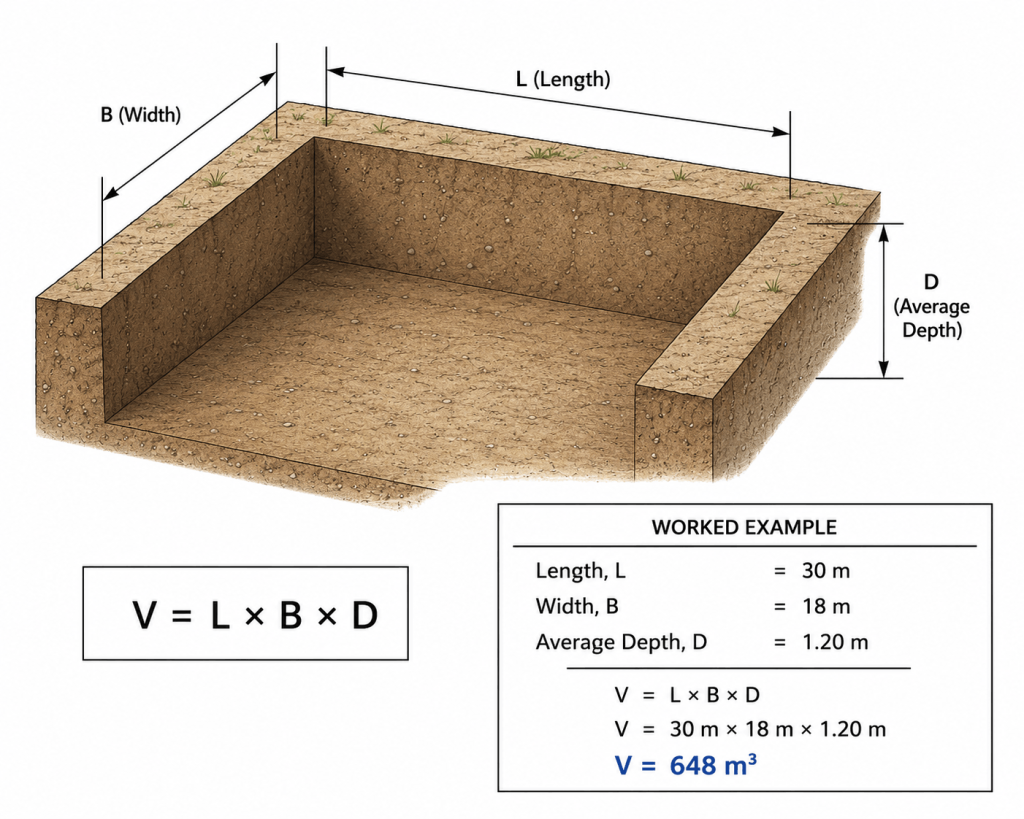
For a rectangular excavation with uniform depth:

Formula
V = L × B × D
Where:
- V = excavation volume in cubic metres
- L = excavation length in metres
- B = excavation width in metres
- D = average excavation depth in metres
Worked Example
A building platform requires excavation over the following area:
- Length = 30 m
- Width = 18 m
- Average depth = 1.20 m
Formula Substitution
V = 30 × 18 × 1.20
Calculation
V = 648 m³
Final Answer
The estimated excavation volume is 648 cubic metres.
This calculation assumes vertical sides and a uniform depth. Additional volume may need to be considered for side slopes, working space, foundation excavations, overbreak or irregular ground levels.
For irregular earthworks, survey-based methods, cross sections, grid calculations or digital terrain models provide more accurate quantities.
Earthworks Productivity and Planning
Earthwork productivity depends on the complete working cycle, not only the excavation equipment.
Main Productivity Factors
- Excavator capacity.
- Soil type.
- Excavation depth.
- Truck capacity.
- Number of trucks.
- Haul distance.
- Traffic conditions.
- Loading and dumping time.
- Equipment breakdown.
- Site access.
- Working space.
- Weather.
- Groundwater.
- Testing frequency.
- Survey availability.
- Disposal-site operating hours.
Equipment Balancing
An excavator may remain idle when there are too few trucks. Trucks may remain idle when the excavator is too small or the loading area is congested.
The construction planner should balance excavation capacity, truck cycle time and disposal capacity.
Workfront Planning
Earthworks should be divided into manageable zones so that:
- Excavation can proceed safely.
- Approved fill areas remain available.
- Tests can be completed without delaying all work.
- Access routes remain open.
- Other trades can start in completed zones.
- Water can be directed away from active work.
Inspection and Testing Allowance
The programme should include time for:
- Formation inspection.
- Density testing.
- Survey verification.
- Rectification.
- Retesting.
- Consultant approval.
Covering work before approval may result in reopening completed areas.
Coordination With Other Trades
Earthworks should be coordinated with the following activities.
Structural Works
Foundation excavation must match structural dimensions, founding levels and working-space requirements.
Excavation should not damage piles, pile heads, blinding or starter bars.
Waterproofing
Basement earthworks should allow sufficient working space for waterproofing, protection boards and drainage systems.
Backfilling should not begin until waterproofing has been inspected and protected.
Underground MEP Services
Drainage, water, electrical and telecom services should be coordinated before final filling.
Uncoordinated excavation can damage completed fill or create clashes with foundations.
Road and Pavement Works
Final formation levels, crossfalls and subgrade conditions should match the pavement design.
Heavy construction traffic should not damage accepted subgrade.
Landscaping
Topsoil should be stored separately and reinstated only in designated planting areas.
Landscape levels should direct water away from buildings unless the drainage design states otherwise.
Retaining Walls
Filling behind retaining walls should follow the structural sequence. Heavy rollers should not operate too close to the wall unless permitted by the design and method statement.
Drainage layers and outlets should remain clear.
Dewatering and Drainage
Temporary drainage should be coordinated with permanent stormwater systems and environmental controls.
Relevant Standards and Codes
Standards commonly associated with earthworks include:
- BS 6031, Code of practice for earthworks.
- BS 1377 series, Methods of test for soils for civil engineering purposes.
- ASTM D698, Laboratory compaction characteristics using standard effort.
- ASTM D1557, Laboratory compaction characteristics using modified effort.
- ASTM D1556/D1556M, Density and unit weight of soil in place by the sand-cone method.
- ASTM D6938, In-place density and water content using nuclear methods.
- ASTM D1883, California Bearing Ratio of laboratory-compacted soils.
- Relevant Eurocodes for geotechnical design, where adopted.
- Applicable local authority requirements for excavation, haulage, disposal and environmental protection.
The contract documents, approved drawings, geotechnical recommendations, project specification and local authority requirements take priority. The project team should confirm the applicable edition and exact testing method before work starts.
Environmental Considerations
Earthworks can have a significant environmental impact if not properly controlled.
Reuse of Excavated Material
Suitable excavated soil should be reused where practical and permitted by the specification. This can reduce imported fill and disposal quantities.
Dust Control
Haul roads, stockpiles and exposed ground may require controlled water spraying.
Water use should be managed to avoid runoff, ponding and damage to compacted surfaces.
Soil Erosion
Temporary drains, silt fences, berms and surface protection may be required to control erosion.
Disposal
Waste soil should only be transported to approved locations.
Contaminated material may require separate testing, transport and disposal arrangements.
Noise and Vibration
Breaking rock and operating heavy equipment may affect nearby properties and workers. Working-hour restrictions and monitoring may be required.
Fuel and Oil Spills
Plant refuelling and maintenance should take place in controlled areas. Spill kits should be available, and contaminated soil should be removed using an approved procedure.
Protection of Groundwater
Pumping and disposal of groundwater should follow project and authority requirements. Silty or contaminated water should not be discharged without appropriate treatment and approval.
Practical Earthworks Site Checklist
- Approved earthwork drawings are available at the site.
- The method statement and risk assessment are approved.
- Existing and proposed levels have been confirmed.
- Survey benchmarks are established and protected.
- Underground and overhead services have been identified.
- Required excavation permits have been issued.
- Excavation limits, slopes and formation levels are marked.
- Suitable and unsuitable material stockpile areas are identified.
- Imported fill has an approved material submittal and source.
- Temporary drainage and dewatering arrangements are ready.
- Excavation sides are safely battered, benched or supported.
- Fill is being placed in controlled layers.
- Moisture content is suitable for compaction.
- Compaction equipment suits the soil and working area.
- Density testing is completed at the required locations and frequency.
- Failed test areas are corrected and retested.
- Final formation levels and drainage falls are verified by survey.
- Approved formation is protected from traffic and water damage.
- Test reports and inspection records are properly filed.
- As-built survey information is completed before handover.
Frequently Asked Questions
1. What are earthworks in construction?
Earthworks are activities that change the existing ground level or profile. They include site clearance, topsoil stripping, excavation, soil transportation, disposal, filling, compaction and final grading. Earthworks prepare stable platforms and formation levels for foundations, roads, utilities and external works.
2. What is the difference between excavation and earthworks?
Excavation is the removal of soil or rock from the ground. Earthworks are broader and include excavation, loading, transport, stockpiling, disposal, filling, compaction and grading. Excavation is therefore one part of the overall earthworks process.
3. What material can be used for earthwork filling?
Fill material should be approved and suitable for its intended location. It should normally be free from organic matter, waste, contamination and harmful oversized particles. Its grading, plasticity, moisture condition and compaction performance should comply with the project specification.
4. Why is earthwork compaction important?
Compaction reduces air voids and increases the stability of placed soil. Properly compacted fill provides better support for foundations, slabs and pavements. Inadequate compaction can cause settlement, cracked finishes, uneven roads and damage to underground services.
5. How is earthwork compaction checked?
Compaction is normally checked using field density tests. The achieved field dry density is compared with a laboratory reference density established by an approved compaction test. The required percentage and testing frequency should follow the project specification.
6. What causes a field density test to fail?
Common causes include excessive layer thickness, incorrect moisture content, insufficient roller passes, unsuitable material, weak ground below the layer or poor compaction near edges. The failed area should be reworked, recompacted and retested.
7. How are earthwork quantities calculated?
Earthworks are normally calculated in cubic metres. Simple excavations can be measured using length multiplied by width multiplied by average depth. Irregular areas may require survey cross sections, grid methods, average end areas or digital terrain models.
8. Can excavated soil be reused as fill?
Excavated soil can be reused when it is suitable, properly tested and accepted for the proposed location. Topsoil, organic soil, contaminated soil and highly unsuitable material should not be used below structural works unless specifically treated and approved.
9. What is over-excavation?
Over-excavation occurs when soil is removed below or outside the required excavation limit. The affected area should not be filled using loose excavated material without approval. It may require approved compacted fill, lean concrete or another treatment directed by the Engineer.
10. What are the main risks during earthworks?
The main risks include excavation collapse, buried services, plant collisions, falling into excavations, groundwater, unstable slopes, dust, noise and damage to nearby structures. Controls should include permits, service detection, safe slopes or support systems, barricades, trained operators and competent supervision